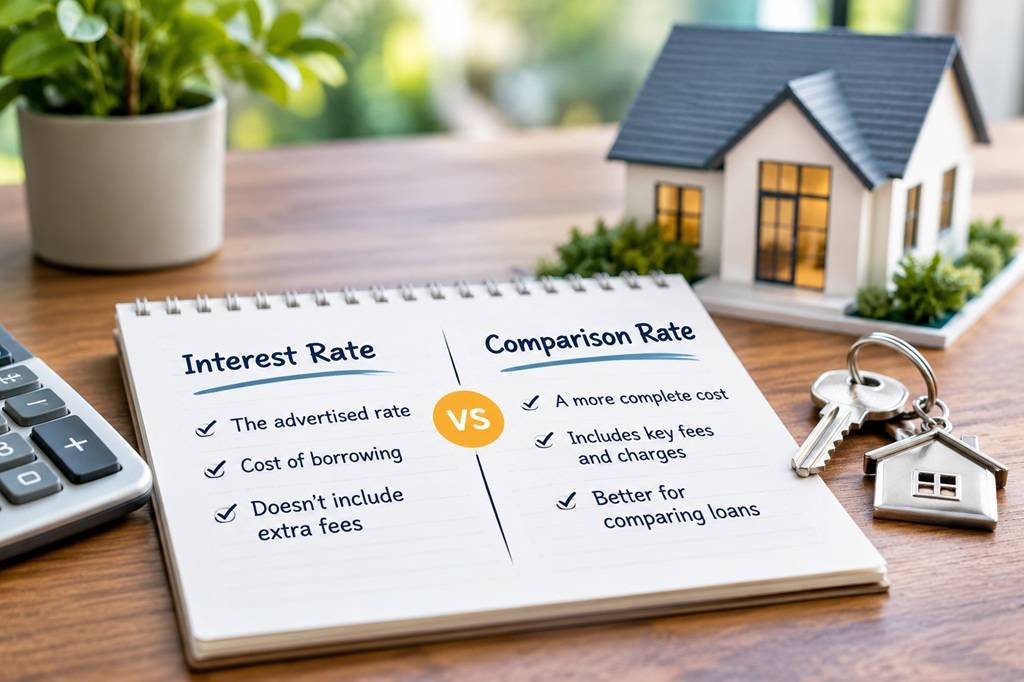
What Is an Interest Rate?
The interest rate is the percentage a lender charges on your loan balance, shown as a yearly rate (p.a.). It sets your repayments. On a variable loan it can change at any time. The Reserve Bank lifted the cash rate to 4.85% on 3 November 2026, its fifth rise of the year (RBA), and most lenders passed that rise on to variable rates.
The catch is that the interest rate tells you nothing about fees. A loan with a low headline rate can still cost more once fees are added.
What Is a Comparison Rate?
A comparison rate combines the interest rate with most of the fees you’ll pay over the life of the loan, shown as one yearly percentage. Australian lenders have had to show it next to any advertised interest rate since 1 July 2003, under the National Credit Code. Every lender uses the same formula, so you’re comparing like with like.
What’s usually included:
- The interest rate, including any revert rate after a fixed or introductory period
- Application, establishment and settlement fees
- Ongoing monthly or annual fees, including package fees
- Discharge fees
What’s usually not included:
- Fees for optional features such as redraw or extra offset accounts
- Break costs on fixed-rate loans
- Government charges such as stamp duty and mortgage registration fees
- Lenders mortgage insurance (LMI)
- Fee waivers, cashback offers and other discounts
Interest Rate vs Comparison Rate at a Glance
| Feature | Interest rate | Comparison rate |
| What it shows | The cost of borrowing the money | Interest plus most lender fees |
| Sets your repayments? | Yes | No |
| Includes fees? | No | Most upfront and ongoing fees |
| Based on your loan? | Yes | No: a standard $150,000 over 25 years |
| Best used for | Working out repayments | A first filter when comparing loans |
Why the Comparison Rate Can Mislead
The standard $150,000 loan over 25 years was a reasonable size in 2003. Today the average new owner-occupier loan is around $735,000 (ABS Lending Indicators), and most borrowers choose a 30-year term.
That matters because fees are mostly fixed dollar amounts. A $395 annual fee is a big share of the cost on a $150,000 loan but a small share on a $600,000 loan. So comparison rates overstate the effect of fees on large loans and can point you to the wrong product.
A worked example
Here are two loans for owner-occupiers paying principal and interest:
| Loan A | Loan B | |
| Interest rate | 6.09% p.a. | 5.89% p.a. |
| Fees | None | $600 upfront + $395 a year |
| Advertised comparison rate | 6.09% | 6.28% |
On the comparison rates alone, Loan A looks cheaper. Here’s what happens on a $600,000 loan over 30 years:
| Loan A | Loan B | |
| Monthly repayment | $3,632 | $3,555 |
| Total cost over 5 years | $217,926 | $215,874 |
| Total cost over 30 years | $1,307,554 | $1,292,243 |
| Comparison rate for this loan | 6.09% | 5.98% |
Loan B costs about $2,050 less over five years and around $15,300 less over the full term, despite its higher advertised comparison rate. On a smaller loan, Loan A could come out ahead. The right choice depends on your loan size and how long you’ll keep it.
Figures are calculated with constant rates and monthly repayments, and are for illustration only.

“Ask the lender or your broker to rerun the comparison rate on your actual loan amount and term. It takes them two minutes, and it often flips which loan looks cheaper. Then ask one more question: what will this loan cost me over the next five years? Most people refinance or sell well before the loan ends, so that’s the number that really counts.”
— Jimmy Champion, Senior Mortgage Broker
How to Work Out the Real Cost of Your Home Loan
- Start with the interest rate to see what your repayments will be.
- Use the comparison rate to shortlist. If one loan’s comparison rate is well above its interest rate, the fees are high.
- List every fee in dollars: upfront, annual, monthly and discharge fees.
- Choose a realistic timeframe. Five years is a sensible test for most borrowers.
- Compare total cost over that period: repayments plus fees, minus any cashback.
- Check the features you’ll actually use. A free offset account can be worth more than a small rate difference if you keep savings in it.
The LoanCalculator.com.au home loan repayment calculator lets you test different rates, loan amounts and terms side by side before you apply.
When Each Rate Matters Most
- Fixed-rate loans: check the comparison rate, because it includes the revert rate that applies once the fixed period ends. A low fixed rate that reverts to a high variable rate shows a higher comparison rate.
- Packaged loans: compare on total cost. Annual package fees are included, but bundled discounts on credit cards or insurance aren’t.
- Introductory rates: the comparison rate usually exposes these, because it accounts for the higher rate that follows.
- Cashback offers: these aren’t in the comparison rate, so subtract the cashback yourself when you work out the total cost.
The Bottom Line
The interest rate tells you what you’ll repay each month. The comparison rate gives a rough picture of fees, but only for a $150,000 loan over 25 years. For a home loan of today’s typical size, compare the total cost over the years you’ll actually hold the loan. At LoanCalculator.com.au, we help you compare loans on that real cost, not just the headline rate.
Recent Posts
- Interest Rate vs Comparison Rate: What’s the Real Cost of Your Loan?

- Personal Loan vs Car Loan: Which Is Better for Buying a Car in Australia?

- Offset vs Redraw: Which Is Better for Your Home Loan?

- How Much Do You Need for a House Deposit in Australia?

- What Is an Establishment Fee? A Simple Guide for Borrowers